
Refit and Maintenance
Refit Contract and Specification: What Must Be in Writing
Most disputes in a refit arise not from bad faith but from expectations that were never written down. A good specification is the document that confirms at the outset that both parties have the same result in mind.
Short answer
The refit contract governs the parties, the time and the price; the specification defines technically what will be done, with which materials, by which method and to which acceptance criteria. In a sound arrangement work items are written in measurable terms, additional work is subject to written approval and the documents to be handed over are listed from the start.
Key points
- The contract sets the legal framework and the specification the technical content; the two are read together.
- Every work item should be defined by scope, product, method and acceptance criterion.
- Additional work should not start without a written definition, its effect on time and price, and approval.
- The extent of the warranty, its exclusions and the content of the handover file should be written at the outset.
Scope and limits of this article#
This article considers what the written framework of a refit should contain from a technical point of view. It is not legal advice; on the legal provisions of the contract, the governing law and dispute resolution, the opinion of a lawyer should be sought. Our aim is to help owner and contractor set down their technical expectations in the same language and in measurable terms.
The distinction between contract and specification#
Two documents complement each other in refit work. The contract governs the parties, the place of work, the duration, the price, the terms of payment and the provisions on insurance and liability. The specification, annexed to the contract, defines the technical content: what is to be done in each zone, which product system is to be used, to what standard surfaces are to be prepared and how the result is to be measured.
A large share of the problems met in the yard arises where the contract is detailed but the specification superficial. The sentence “the yacht shall be painted” is legally valid and technically empty, because it states neither the standard of preparation, nor the number of coats, nor the thickness, nor the acceptance criterion. Each party reads it according to its own expectation, and the difference emerges on the day of handover.
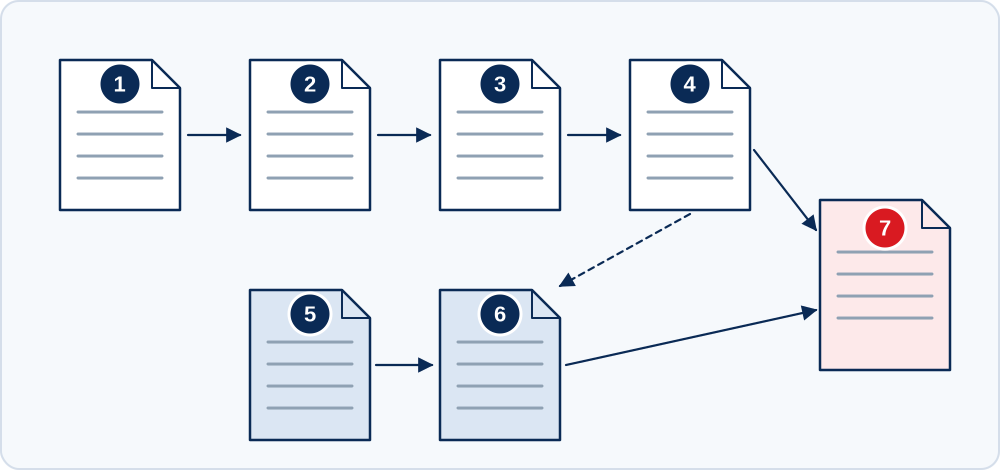
- Condition survey report: findings and readings
- Specification: work items, products, acceptance criteria
- Contract: parties, duration, price, liability
- Schedule and payment plan: stages and their dates
- Variation order: written approval of changes
- Stage acceptance records: measurements and photographs
- Handover file: the document in which all records are collected
The four components of a work item#
A well-written work item answers four questions: where, with what, how and against what it will be accepted.
| Component | Incomplete | Complete |
|---|---|---|
| Scope | Hull paint | Topsides from above the waterline to the gunwale, both sides and transom, approximately 85 square metres |
| Product | Good-quality paint | Epoxy primer and two-pack polyurethane topcoat system, manufacturer and product named |
| Method | Sand and paint | Removal of hardware, sanding of the existing coating back to a sound layer, filling, two coats of primer, intercoat sanding, three sprayed topcoats |
| Acceptance | Good appearance | Dry film thickness within the data sheet range, no runs or sags, gloss consistent between areas, measurement record handed over |
Writing acceptance criteria#
An acceptance criterion defines how it will be established objectively that a job is finished. Criteria should rest as far as possible on measurable quantities.
- For coating work: dry film thickness, adhesion test result, and records of temperature, relative humidity and dew point during application.
- For laminate repair: a crisp note under tap testing, repair thickness matching the surrounding laminate, hardness measurement.
- For osmosis treatment: moisture readings falling to a stable level at the end of drying, and the total thickness of the barrier coat.
- For metal work: thickness and material certificate of renewed plate, visual and where necessary non-destructive examination of welds.
- For systems: pressure test, insulation resistance measurement, functional trial.
Regulating additional work#
Additional work is unavoidable in a refit; the problem is not that it arises but how it is handled. The contract should define the variation procedure explicitly.
- Finding
The circumstance requiring additional work is reported in writing with a photograph and a brief description.
- Definition
The work is written as a work item with its four components.
- Effect
Its effect on price and delivery date is stated.
- Options
Where possible, at least two solutions and their consequences are presented.
- Approval
Work does not begin without the owner’s written approval.
- Record
The approved variation is entered in the budget and the schedule.
The only exception is an emergency in which waiting would damage the vessel. The contract should define such situations separately, together with the limit of the measures the contractor may take without awaiting approval.
Site access, supervision and communication#
When and on what conditions the owner, or the captain or surveyor appointed by the owner, may enter the site should be settled at the outset. Uncontrolled entry into a paint tent leaves dust and marks in a wet film; presence on site during blasting or hot work carries a safety risk. In return, the contractor should undertake to notify the owner at critical stages and to allow inspection before a stage is closed. Closing up a laminate, applying primer over filler and inspecting the surface before the topcoat are typical examples of such hold points.
Time, delay and waiting#
The contract should contain not only the delivery date but also the conditions that affect it. Days on which paint cannot be applied because of the weather, decisions awaited from the owner, materials the owner is to supply and approved additional work all alter the delivery date. If the way these items are reflected in the time is settled at the outset, delay ceases to be a matter of dispute. The schedule should be annexed to the contract, and changes tracked on it.
Stage payments#
Tying payments to completed and accepted stages balances the interests of both parties. Stages should be technically meaningful points: completion of removal and preparation, acceptance of structural repairs, completion of primer coats, acceptance of the topcoat, launch and handover. For each stage the acceptance criterion and the record to be presented are stated. Making the final payment conditional on delivery of the handover file ensures that documentation is actually produced.
Warranty#
A warranty clause should answer three questions: what it covers, for how long and in which circumstances it does not apply. For coating work a warranty generally covers application-related defects such as loss of adhesion, blistering and premature loss of gloss; mechanical impact, collision, unsuitable cleaning chemicals and failure to carry out recommended maintenance are excluded. The product manufacturer’s warranty conditions and the contractor’s workmanship warranty are separate and should be stated separately.
Handover documents#
The documents to be handed over should be listed in the contract. A typical handover file contains the following.
The content and function of the handover file are discussed in detail in the article on handover.
Conclusion#
The contract and the specification turn the technical intention of a refit into a binding text. Writing work items with their four components, making acceptance criteria measurable and settling the variation procedure at the outset prevent most disputes before they arise. An expectation that is not in writing cannot be proved on the day of handover.
Is a written specification needed for small jobs as well?
Yes. The size of the job changes the length of the specification, not the need for it. Even a one-page specification should contain scope, product, method and acceptance criterion.
Is it enough to write “in accordance with the manufacturer’s data sheet” as the acceptance criterion?
It is a good start, but it should also state which data sheet of which product applies and by which measurement records conformity will be shown.
What happens if I do not approve additional work?
The work is not done and the finding is recorded. The contractor should state in writing the consequences of not doing it and its effect on the warranty.
Was this guide helpful?
Thank you! Your feedback has been saved.
Guide content is for general information; in practice, the current technical data sheet of the product applies.
Keep reading
Related guides
Tank Inspection, Maintenance and Repair: Holiday Testing, Thickness Measurement and Records
Inspection, thickness measurement, holiday testing, repair approaches and records for steel boat tanks, summarised from source accounts with their limits.
10 min read Refit and MaintenanceGrey Water, Black Water and Shower Tanks: Corrosion, Lining and Design
Why grey, black and shower tanks on steel boats corrode, what an internal lining does and design details, summarised from source accounts.
11 min read Refit and MaintenanceDrinking-Water Tank Epoxy Lining: Selection, Stripe Coat, Cure and Disinfection
Product documents, stripe coat, cure, flushing and disinfection steps in epoxy lining of drinking-water tanks, summarised from source accounts with their limits.
11 min read